Vagueness
The first action still requires too many decisions.
A practical nonfiction book for when knowing what to do is not enough
START LIGHT helps you understand why a task can be clear, important, and objectively small, yet still feel difficult to enter. It gives you a practical system for making one visible move, keeping the work contained, stopping deliberately, and returning without punishment or catch-up.
A small task can carry a large cost
A four-minute task can carry four days of dread.
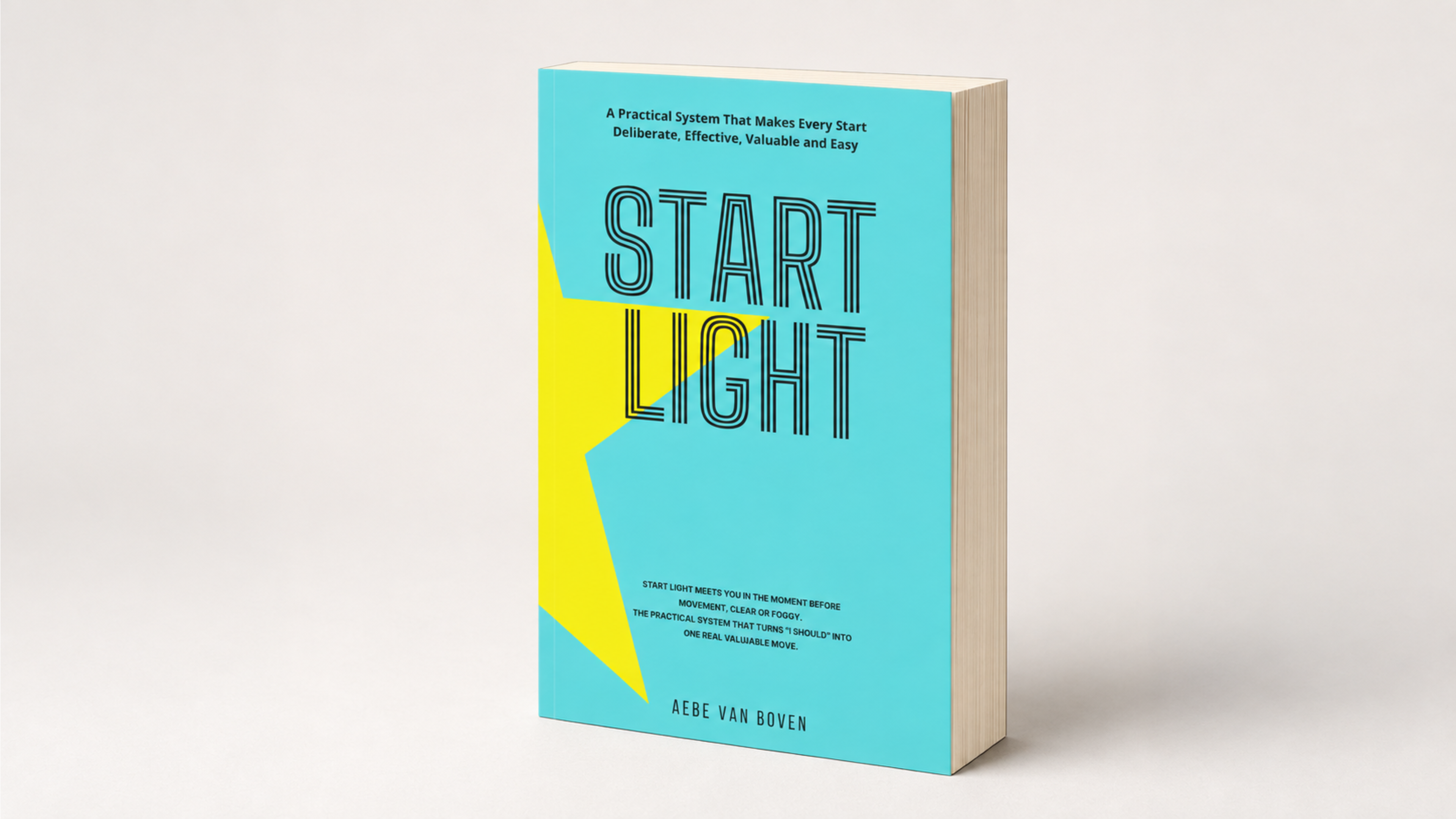
Understand Why Starting Feels So Hard
and Learn How to Make It Lighter
Maybe this is why you are here
Or the task is so unclear that every possible beginning creates another decision.
The email would take four minutes. You have carried it for four days.
You know exactly what to do. Your hands still do not begin.
You keep researching, planning, or preparing because the real work would make the result visible.
The work matters so much that the first version feels like a verdict on your ability or future.
You can work under pressure, but calm time does not reliably produce movement.
You avoid beginning because previous sessions took more time and energy than you intended to give.
You missed several days. Now returning feels heavier than the work itself.
One disrupted day turns the entire week into evidence that the system has failed again.
If any of this feels familiar, START LIGHT was written for the gap between caring about what matters and being able to make, contain, stop, and renew real contact with it.
See how START LIGHT helpsThe missing measurement
Start Cost is the psychological and practical price attached to entering an action before visible work begins. The clock measures minutes. You experience the ambiguity, exposure, decisions, previous attempts, available energy, environmental pull, and whether you trust the work to end.
Two minutes of work and two minutes of Start Cost are not the same measurement.
That is why shortening a task does not always make it enterable. A two-minute action can still be vague, public, irreversible, loaded with shame, or connected to a session with no believable ending.
A heavy task is rarely one giant obstacle. One source of friction is usually charging more than the others. Find the loudest cost and lower that one first.
The first action still requires too many decisions.
Beginning feels exposing, consequential, or tied to identity.
Effort produces no visible proof that anything changed.
The surroundings provide easier exits than the task provides entry.
The action is priced for a capacity that is not available today.
You don’t fix yourself. You fix the entry.See the complete action cycle
The complete action cycle
START LIGHT identifies six ordinary moments where meaningful action can stall. They are not six steps to complete in order. They are six different problems, each of which needs a different response.
You know what matters, but cannot cross into the first visible action.
The first version is being asked to begin the work and prove your worth at the same time.
You begin, but the session drifts, expands, or produces no visible evidence that contact occurred.
Guilt, momentum, or fear of losing progress prevents deliberate closure.
A gap has acquired shame, explanation, and catch-up debt, making re-entry more expensive than the original work.
Interrupted plans and unfinished loops raise the cost of the next day before it begins.
You do not need the whole Toolbox at once. First identify the moment you are actually in. Then use the smallest tool designed for that problem.
Start Light.
Stop Tight.
Return Clean.
A different success standard
START LIGHT calls this runnability: whether the system remains usable under actual rather than ideal conditions.
The entry was affordable enough to perform.
One visible Artifact now exists.
The session ended by decision rather than collapse.
The next return is clearer or lighter than before.
Output still matters. Runnability protects the conditions that make meaningful output repeatable.
The books were not the problem
I could underline a book, explain its method at dinner, and still fail to live a line of it on a tired evening. For a long time, I mistook that gap for failure.
START LIGHT is not intended to replace habits, planning, focus, priorities, or meaningful goals. It works as a practical operating layer beneath and around them: making today’s contact visible, keeping the session bounded, and preserving a usable return after real life interrupts.
A habit system can help a behavior repeat. A planning system can clarify the next action. A focus system can protect concentrated work. START LIGHT addresses the moments when the clarified action still feels expensive, or when stopping and returning are what keep the system from surviving.
Try one move now
A broad intention such as “work on the project” names a territory, not an executable action. A Filmable Entry names what your hands do, where they do it, and what changes first. It does so clearly enough that a camera could record the beginning.
Work on the project.
Open the latest document and write three rough headings.
The larger goal did not become less important. The first contact became clear enough to perform, visible enough to verify, and small enough to evaluate honestly.
The book, in practice
Learn how to:
Begin before motivation, confidence, or the perfect mood arrives.
Turn an overwhelming task into a first move you can actually make.
Understand how guilt and self-judgment can raise the price of the next attempt.
Know what to do when your mind is foggy and the next step is unclear.
Choose a smaller valid cycle when the day cannot safely or realistically carry the full one.
Protect what matters without demanding more than today can give.
Stop working before effort turns into resentment or collapse.
Leave your work ready for an easier return tomorrow.
Come back after a gap without punishing yourself, catching up, or starting over.
Keep important plans alive through interrupted weeks and difficult seasons.
Make smaller agreements that leave visible evidence and a believable way back.
Install a start–stop–return loop that can survive interruption and changing capacity.
Twelve skills for turning understanding into a method you can actually run.
The method in ordinary life
Resistance speaks a different dialect in your banking app than it does at the gym, in an unsent message, or beside the dream that has slowly become furniture. START LIGHT translates the same method into four real territories.
It has charged you several times a day without being opened once. Today’s move is not “fix the finances.” Open it. Read the first line. Reality contact is an artifact.
They do not need to begin a transformation. Put them on and step outside. On a hard day, the doorstep can be the complete and honest entry.
Do not ask one opening line to repair the whole relationship. Draft it under NOT SENDING YET. Contact and commitment are separate moves.
Open the file, case, course, or app. Leave one visible mark. Tonight the dream does not need your best hours. It needs to know you still live at this address.
Inside START LIGHT
The book first explains why action becomes expensive. It then teaches you how to identify the stalled moment, make one visible entry, leave real evidence, stop deliberately, prepare the next return, and install the method across ordinary and interrupted weeks.
The Push Myth, start cost, friction, and the five guards that quietly make a doorway expensive.
Cooperation Mode, filmable entries, focus, mini-autonomy, meaning, and direction, including what to do when the next move is still unclear.
Sub-resistance starts, the Return Protocol, adaptive rhythm, definition of enough, and a month built for installation.
The back of the book is built for use
You do not need to remember the whole book when something stalls. Identify whether the problem is fog, exposure, too many choices, no trusted stopping point, shame after a gap, or a broken week. The Toolbox then routes you to one relevant protocol.
Research-informed. Mechanically practical.
The evidence layer documents, chapter by chapter, the research the method draws from: procrastination as mood repair, implementation intentions, self-determination, attention, habit formation, and more. It also identifies where scientific debate remains open.

Why I wrote START LIGHT
What the promise means to me
When I say, “Turn what once held you back into the strength that moves you forward,” I am not asking you to romanticize pain or pretend every hard season was secretly a gift.
For me, it means that pain, hesitation, failed starts, and periods of not knowing taught me to notice what force had missed: clarity, exposure, capacity, choice, stopping, and return. The past is not the strength. What you learn to build because of it can become one.
“I should” lives in the head.One real move appears in the world.
Sometimes that move is opening the file. Sometimes it is defining what “done” would look like. Sometimes it is sending one line, preparing tomorrow’s shoes, or admitting that recovery is today’s honest lane. Small does not mean meaningless. It means contact has begun.
Three ways in
Every edition contains the complete fourteen-chapter START LIGHT reading system, Toolbox, Month Practice, and supporting material. Choose according to how you want to read and work with the method.
Digital edition
The complete START LIGHT reading system in its lightest portable format. Choose Kindle when you read primarily on a device or want immediate access wherever a difficult start, stop, or return appears.
439 pages
The complete system in a flexible physical edition. Choose paperback when you want to underline, annotate, and repeatedly return to the chapter, tool, or protocol that matches the moment.
471 pages · Complete book plus exclusive Field Edition companion
The complete START LIGHT reading system plus an exclusive working companion. Choose this edition when you want to diagnose the moment, write directly into the system, and install the method across four weeks.
This is not simply the same book in a harder cover. It is the complete book plus its physical diagnosis and installation companion.
Before you choose
No. It works on both sides of clarity. When the next move is still unclear, the method helps you define what “done” would look like and turn a broad territory into one physical action. When the move is already clear but still feels heavy, it helps you identify and lower the cost attached to entering, containing, stopping, or returning.
Treat clarity as the first task. Write one sentence answering “What would done look like?” Then ask what your hands could do first. Make that action camera-visible and small enough to evaluate honestly. If you still cannot answer, narrow the Lane until one physical contact becomes possible.
Knowing the next action does not automatically make it enterable. The action may still feel exposed, irreversible, open-ended, mismatched to today’s capacity, or connected to a session you do not trust to end. START LIGHT helps you identify which cost is active and lower that one.
START LIGHT belongs beside productivity, habit, focus, planning, and behavior-change books, but it solves a more specific operating problem: what to do when a useful intention still does not become real contact. It begins with entry, then includes leaving visible evidence, stopping deliberately, preparing the next return, and keeping the system usable across interrupted weeks.
No. Size is only one source of cost. A small action can still be vague, exposed, irreversible, open-ended, mismatched to today’s capacity, or loaded with shame. START LIGHT makes the first contact visible, requires one real Artifact, defines the stopping point, and prepares the return.
Atomic Habits primarily helps readers shape and repeat behavior through cues, environment, identity, and easier actions. START LIGHT focuses on the moments when contact itself remains expensive, even when the action is already small or understood. It also adds explicit tools for visible entry, stopping, restart, and return after interruption. The two systems can be used together.
No. Discipline remains useful, especially when difficult work or real consequences require it. START LIGHT asks whether avoidable friction is making ordinary action require emergency force every time. The goal is not to eliminate effort, but to stop paying unnecessary costs before the work has even begun.
Some START LIGHT tools may be useful for making actions concrete, changing cycle size, containing work, or preparing return under uneven conditions. The book does not diagnose, treat, or cure any condition and does not replace medical, psychological, or professional care. Seeking qualified support may itself be the correct first visible action.
It does not erase technical difficulty, consequences, grief, illness, skill gaps, or external constraints. It helps identify and reduce unnecessary cost around the next honest move. The work may remain demanding while the entry, stop, and return become clearer.
You do not catch up or stage a punishment-driven restart. You name the fact of the gap, choose one Lane, make one Filmable Entry, leave one Artifact, write the Restart Line, and stop cleanly. START LIGHT defines consistency through reliable return rather than perfect attendance.
No. Read linearly when you want the complete explanation, or use the Situation Index and Toolbox when you need help with a specific moment now. The book routes you to the chapter or protocol that matches Start, Quality, Work, Stop, Return, or Week.
No. The same operating loop can be used around administration, health, relationships, creative work, responsibilities, and personal projects. The content changes; the need for a visible entry, real evidence, a deliberate stop, and a usable return does not.
No. Identify the moment you are actually in, then open only the relevant drawer. The 60-Second Daily Card remains the light daily interface; the rest of the Toolbox is there for specific forms of friction and interruption.
Every edition contains the complete reading system. Choose Kindle for immediate portable access, paperback for a flexible physical copy you can annotate, or the Hardcover Field Edition when you want the complete book plus the Quick Map, eight Field Plates, working pages, Four-Week Installation Record, and A Letter for the Day You Fall Off Again.
START LIGHT · Field Notes
Receive practical notes for the moments when action becomes expensive: beginning, quality pressure, work that expands, stopping, returning, and keeping a week runnable.
No daily motivation. No artificial urgency. No punishment for falling behind.
Unsubscribe at any time. Missing an email creates no catch-up debt.
Wherever action has become expensive
If the next step is clear but heavy, lower one cost. If it is unclear, make clarity the first task. If the work usually expands beyond what you can afford, define the stop before beginning. If you have been away, return without catch-up or punishment. You do not need a different personality to make one honest move.
Begin what matters. Stop before force turns into collapse. Return without punishment or shame.
Explore the three editionsNow available · Kindle · Paperback · Hardcover Field Edition

